

ISO 14155 Audit Services
Independent GCP audits of medical device clinical investigations, for sponsors, CROs, investigator sites and clinical vendors.
ISO 14155 is the international Good Clinical Practice (GCP) standard for clinical investigations of medical devices in human subjects. Our auditors check that your investigation is designed, conducted, recorded and reported in line with ISO 14155:2026, the clinical investigation plan (CIP) and the EU MDR, FDA and UK requirements that apply to it.
Last reviewed: November 2026
What is an ISO 14155 audit?
An ISO 14155 audit is a systematic, independent review of a medical device clinical investigation. It establishes whether trial activities, documents and data comply with the CIP, ISO 14155, the sponsor's procedures and the applicable regulations, and whether the reported data are credible and traceable to source.
Auditing is not the same as monitoring. Monitoring is the sponsor's routine oversight of an ongoing investigation. An audit is carried out by someone independent of the study team and tests whether the whole system, including monitoring, is working.
Who needs ISO 14155 audits?
- Sponsors and manufacturers overseeing investigator sites, CROs and vendors, and preparing for notified body, competent authority or FDA review
- CROs auditing their own processes or subcontractors, or demonstrating ISO 14155 compliance to sponsors
- Investigator sites and site networks preparing for a sponsor audit or regulatory inspection
- Clinical vendors such as EDC providers, core laboratories, imaging centres and adjudication committee providers
Which clinical investigations does ISO 14155 cover?
- Pre-market clinical investigations supporting CE marking under the EU MDR (Articles 62 to 82 and Annex XV)
- PMCF investigations of CE-marked devices under MDR Article 74
- Other clinical investigations under MDR Article 82, including investigator-initiated studies
- FDA IDE studies under 21 CFR Parts 812, 50 and 56, and investigations outside the US whose data support FDA submissions (21 CFR 812.28)
- UK clinical investigations notified to the MHRA
- Software as a medical device (SaMD) and AI device studies
ISO 14155 does not apply to in vitro diagnostic devices. IVD clinical performance studies follow the IVDR and ISO 20916, and are supported by our IVD clinical and post-market team.
Why ISO 14155 audits matter
- Data that cannot be relied on. Reviewers can discount data from poorly conducted investigations, leaving gaps in your clinical evaluation report.
- Subject safety. Weak consent, eligibility or safety reporting processes put participants at risk.
- Delays to market. Late findings can mean extra data collection or a further investigation before CE marking or FDA submission.
- Sponsor accountability. You can delegate tasks to a CRO, but you remain responsible for the investigation. Independent audits evidence that oversight.
What changed in ISO 14155:2026?
ISO published the fourth edition of ISO 14155 on 23 March 2026. It replaced ISO 14155:2020 with immediate effect and no transition period. In the EU, EN ISO 14155:2026 became a harmonised standard under the MDR on 10 November 2026 (Commission Implementing Decision (EU) 2026/2479). The previous reference, EN ISO 14155:2020/A11:2024, continues to give presumption of conformity until 10 May 2028.
- Risk management for the investigation. Residual risks from device use, managed under ISO 14971, are now separated from risks created by clinical procedures outside routine practice, which need their own documented assessment.
- Data Monitoring Committees. DMC responsibilities must be documented, and a decision not to have a DMC must be justified.
- Clinical Event Committees. A new section covers CECs, to make event adjudication consistent and reduce bias.
- Adverse event reporting. Sponsor responsibilities, reporting pathways and timelines are clarified.
- Study design. A new informative Annex K covers clinical investigation design.
Still working to ISO 14155:2020? We review your SOPs, templates and live investigations against the 2026 edition and give you a prioritised plan to close the gaps. Book a gap assessment
Our ISO 14155 audit services
All audits are risk-based and conducted against ISO 14155:2026, the CIP and the regulations that apply to your investigation.
Investigator site audits
- Pre-study site qualification and initiation readiness
- Routine audits of high-enrolling, high-risk or newly activated sites
- For-cause audits after deviations, safety signals or data anomalies
- Close-out audits before database lock
CRO and clinical vendor audits
- CRO qualification and requalification
- EDC, eCOA and IRT system providers
- Core laboratories, imaging and reading centres
- CEC, DMC and adjudication service providers
- Investigational device logistics and storage
Sponsor system and process audits
- Clinical SOPs and processes against ISO 14155:2026
- Trial master file (TMF and eTMF) audits
- Safety reporting, including device deficiencies
- Investigational device traceability and accountability
- Clinical risk management and monitoring oversight
Data and documentation audits
- Data management, statistics and reporting
- Computerised system validation and audit trail review
- ALCOA+ data integrity and source data verification
- CIP, investigator's brochure, informed consent and clinical investigation report reviews against ISO 14155 and MDR Annex XV
Mock inspections and inspection readiness
- Notified body, competent authority and FDA mock inspections
- Interview preparation for clinical, QA and site staff
Planning a site, CRO or vendor audit? Send us the investigation, countries and timelines, and we will come back with a proposed scope, auditor and quote. Request a quote
How our ISO 14155 audit process works
Every audit follows a structured, risk-based method.
Step 1 - Scoping and risk assessment
We agree the audit type, scope and objectives with you, using study risk, enrolment and any known issues to focus effort.
Step 2 - Auditor assignment
We assign an auditor with relevant device and therapeutic area experience, working in the local language where possible.
Step 3 - Audit preparation
You receive an audit plan, agenda and document request in advance, so time on site is spent reviewing rather than retrieving.
Step 4 - Audit execution
On site, remote or hybrid, with opening and closing meetings so findings are discussed before you receive the report.
Step 5 - Audit reporting
Findings are graded by criticality and referenced to the relevant ISO 14155 clause, CIP section or regulatory requirement. Reports can use your templates or ours.
Step 6 - CAPA follow-up
We review your CAPA plan, verify effectiveness and run follow-up audits where needed. Read more on making your CAPA process work.
What our auditors review
- Approvals: ethics committee opinions, competent authority authorisation or notification, and document version control
- Informed consent: correct approved version, obtained before any study procedure, process documented
- CIP compliance: eligibility, visit schedule and procedures, with deviations recorded and assessed
- Safety reporting: adverse events, serious adverse events and device deficiencies reported within required timelines
- Investigational device: accountability, labelling, storage, traceability and returns
- Delegation and training: delegation log and training completed before tasks are performed
- Source data and CRFs: accuracy, completeness and reliable audit trails
- Monitoring: monitoring plan followed, visit reports timely, issues escalated and resolved
- Committees: DMC and CEC charters, independence, decisions and minutes
- Essential documents: investigator site file and TMF complete and current
Preparing for a notified body review or FDA inspection? A mock inspection shows you what an inspector will find while there is still time to fix it. Book a mock inspection

Trusted by top-tier teams worldwide

















650+
Audits conducted in the last year
800
Network of expert GxP Auditors
110
Countries covered
Why choose Apotech for ISO 14155 audits?
Our onsite, remote and hybrid audits help medical device manufacturers, CROs and investigator sites generate clinical data that stands up to notified body, competent authority and FDA scrutiny.

Medical device GCP specialists
Senior auditors with clinical, QA and regulatory backgrounds and a minimum of 20 years' experience, covering 110 countries in local languages.

Device and drug GCP under one roof
We audit to ISO 14155 and ICH E6(R3), which suits combination products and mixed portfolios. See our GCP audit services.

We provide competitive pricing
Our local auditors help minimise travel and expense costs, keeping our services cost-effective

Single audits or full programmes
One-off audits or complete programmes across investigations, sites and vendors, including scheduling, vendor qualification, reporting and CAPA tracking.
Our Global Reach
We take pride in our extensive global audit network and are committed to utilising local auditors based in-country.
This approach offers several key benefits: local auditors possess in-depth knowledge of regional regulations, communicate effectively in the local language, and help reduce travel expenses for our clients. We have successfully provided support in all the regions highlighted on the map below.
Featured case studies
FAQs on ISO 14155 audits
Here are the questions sponsors, CROs and sites ask us most often about ISO 14155 audits.
Have a question we have not answered? Ask one of our auditors
ISO 14155 is the international standard for Good Clinical Practice in clinical investigations of medical devices in human subjects. It sets requirements to protect the rights, safety and wellbeing of participants, ensure the scientific conduct of the investigation and the credibility of its results, and define the responsibilities of the sponsor and principal investigator. The current edition is ISO 14155:2026.
ISO 14155 and ICH GCP: what is different?
Both share the ethical foundation of the Declaration of Helsinki, but they are written for different products and regulatory frameworks.
| ISO 14155 | ICH E6 GCP | |
|---|---|---|
| Applies to | Clinical investigations of medical devices | Clinical trials of medicinal products |
| Current version | ISO 14155:2026 | ICH E6(R3) |
| Status | Voluntary standard, harmonised under the EU MDR | ICH guideline adopted by regulators including EMA, FDA and MHRA |
| Key study documents | Clinical investigation plan, investigator's brochure, clinical investigation report | Protocol, investigator's brochure, clinical study report |
| Safety terms | Adverse device effects, device deficiencies, serious adverse device effects | Adverse drug reactions, SUSARs |
| Risk management | Linked to ISO 14971, plus risks from investigation procedures | Quality risk management across the trial |
| Does not cover | In vitro diagnostic devices (see ISO 20916) | Medical device investigations |
Running a combination product or drug-device study? Our auditors work to both standards, so one team can cover both sides of your programme. Speak to a GCP auditor
Compliance, standards and quality assurance
Apotech operates in alignment with ISO 14155, the EU MDR, ISO standards, GxP requirements and the expectations of regulators including FDA, MHRA and EU competent authorities. All engagements maintain independence, objectivity and confidentiality.
Data protection and confidentiality
We apply strict data protection measures, GDPR-aligned processes and secure communication protocols to safeguard sensitive information throughout the audit lifecycle.
Related MedTech services
- Clinical trial consulting: study design, CIP and investigator's brochure
- Clinical evaluation plans and clinical evaluation reports
- Post-market clinical follow-up
- ISO 14971 risk management
- EU MDR, IVDR and MDSAP audits
- ISO 13485 audits
Helpful resources
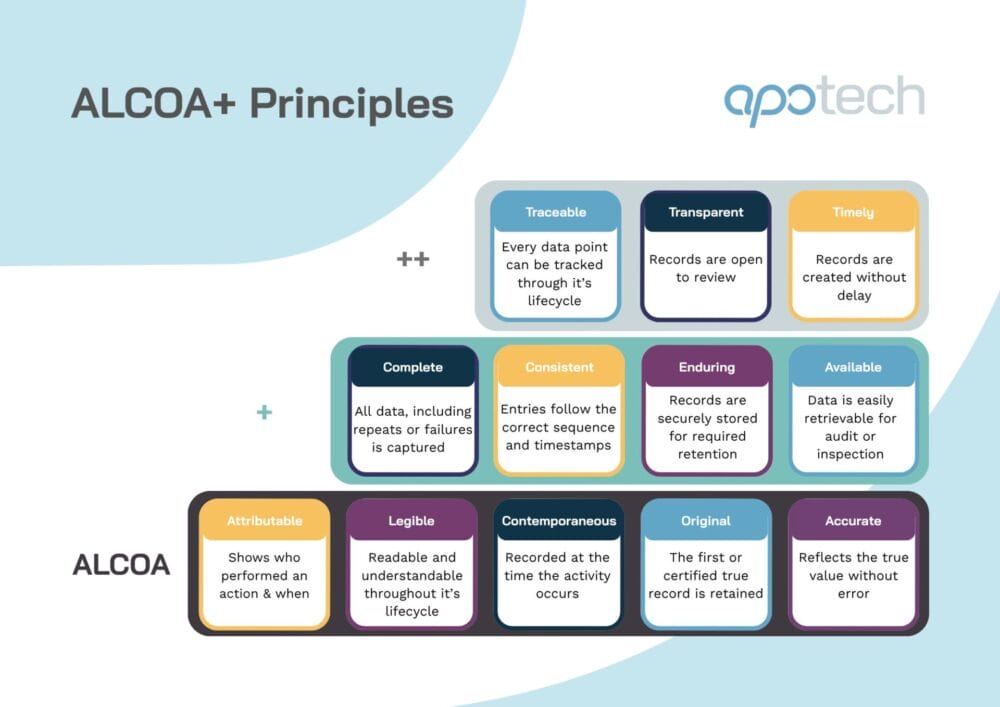
ALCOA+ Principles in Pharma: The Next-Gen Standard for Data Integrity
ALCOA+ and the modern data integrity landscape Data integrity underpins regulatory compliance and patient safety. And as pharmaceutical and biotech organizations adopt increasingly digital systems, automated workflows, and globalized supply chains, regulators including the FDA, EMA, and MHRA have intensified their focus on how data is generated, captured, and maintained. The ALCOA+ principles form the…

GxP Compliance Explained: Beyond Best Practice
Understanding the meaning of GxP is essential for any organization operating in the life sciences sector. In simple terms, GxP refers to “Good Practice” quality and regulatory guidelines, used to ensure products are safe, effective, and reliable throughout their lifecycle. These standards apply across pharmaceuticals, biotechnology, medical devices, and laboratory environments, and are enforced by…
How To Master The CAPA Process Step-by-Step: From Identification to Implementation
The Corrective and Preventive Action (CAPA) process is a core mechanism within Pharmaceutical and Biotech quality systems, designed to identify, address, and prevent issues that may impact compliance, product quality, and most importantly, patient safety. In regulated environments, CAPAs are not isolated actions but structured responses embedded within a wider quality management framework. CAPAs are commonly triggered by internal…